
What Is New in Gaming Technology Jogametech? 2026 Trends and Innovations
Gaming technology has changed considerably over the past few years. Players no longer judge a game only by its graphics or how quickly it loads. They also care about realistic characters, responsive controls, smoother performance, immersive sound, and the freedom to play across different devices. In 2026, artificial intelligence, advanced graphics processing, cloud gaming, and immersive hardware are making these experiences more accessible and sophisticated.
If you are searching for what is new in gaming technology jogametech, the biggest developments to understand include AI-powered gameplay, smarter graphics, handheld gaming PCs, virtual reality, and improved cross-platform experiences. These innovations are changing how developers create games and how players experience them.
Jogametech is presented as a gaming information platform covering PC, console, mobile, and AR/VR gaming, alongside news, reviews, and guides. Understanding its coverage in the context of wider gaming developments can help readers explore the technologies shaping the industry.
Let’s look at the innovations that matter most and what they actually mean for everyday gamers.
What Is Jogametech and How Does It Relate to Modern Gaming?
Jogametech is associated with gaming news, reviews, guides, and discussions about developments across the gaming industry. Its website highlights several areas, including PC gaming, console gaming, mobile gaming, and augmented and virtual reality.
Rather than referring to one particular gaming console or hardware technology, the term is best understood in the context of the gaming information platform and the subjects it covers.
For players, this means exploring developments from different parts of the gaming ecosystem. A PC gamer might be interested in graphics cards and performance optimization, while a console player may care more about visual improvements, controller technology, and exclusive releases.
Mobile gamers have different priorities, including battery efficiency, touchscreen responsiveness, and network performance.
Understanding these differences makes it easier to evaluate which gaming innovations are genuinely useful rather than simply following every new technology announcement.
What Is New in Gaming Technology in 2026?
Gaming technology in 2026 is developing across several connected areas. Some innovations are already available in commercial products, while others are still being introduced or tested by developers.
Here are the most important developments worth understanding.
Artificial Intelligence in Video Games
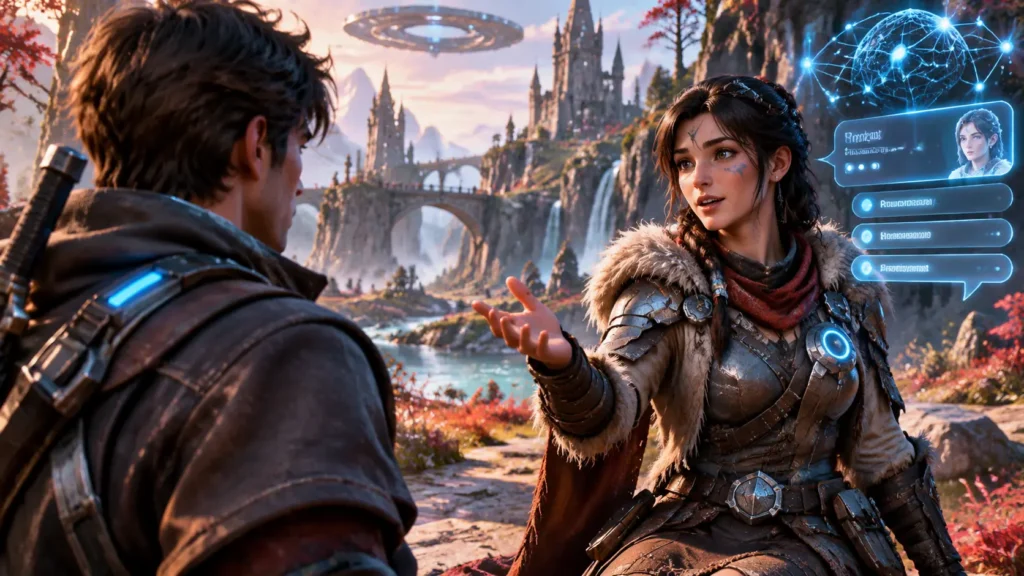
Artificial intelligence is becoming an important part of modern game development. Traditionally, non-player characters (NPCs) followed predefined instructions. Their conversations, reactions, and movements were generally controlled by scripts written by developers.
AI is creating opportunities for more responsive characters and environments.
For example, imagine playing an adventure game in which a character remembers an earlier conversation and responds differently when you meet again. Instead of repeating the same dialogue, the character could react according to previous interactions or events in the game.
AI can also help developers with:
- Creating variations in character dialogue.
- Testing gameplay mechanics.
- Identifying bugs and performance problems.
- Generating development assets.
- Adjusting certain gameplay experiences.
- Supporting procedural world creation.
Google Cloud discussed the development of AI agents and more responsive gaming environments in March 2026, highlighting how studios are exploring ways to create more dynamic experiences.
However, AI-powered characters are not automatically better than traditionally designed characters. Their usefulness depends on response quality, consistency, performance, and how well they fit the game’s story.
AI-Powered Graphics and Frame Generation
Graphics improvements are no longer dependent only on installing a more powerful graphics card.
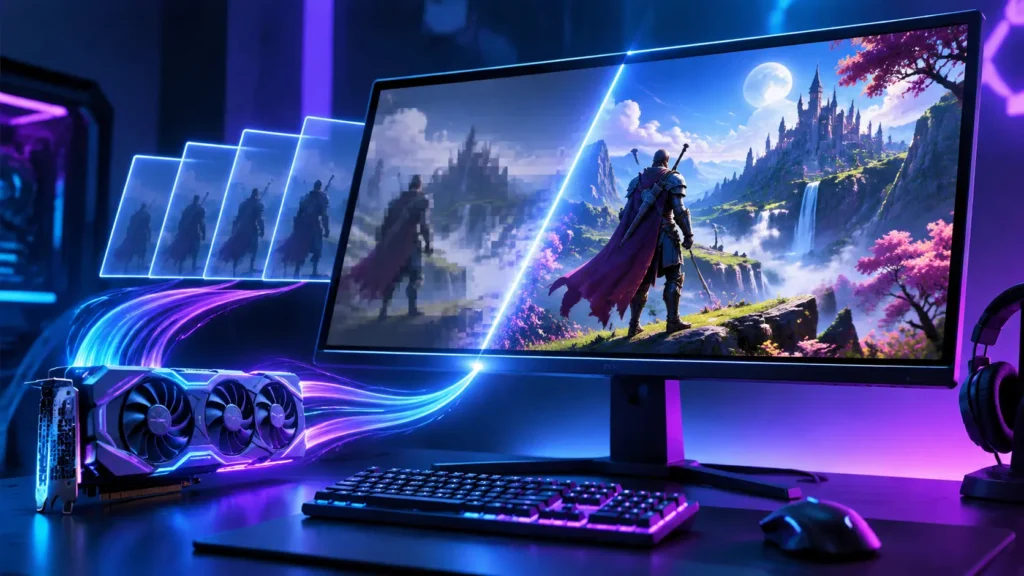
AI-based upscaling allows a game to render an image at a lower resolution and reconstruct it into a sharper image. This can help maintain visual quality while reducing the workload on the GPU.
Frame generation takes a different approach. It creates additional frames between traditionally rendered frames to make motion appear smoother.
These technologies are especially useful for PC gamers who want higher frame rates without necessarily purchasing the most expensive graphics hardware.
Console gaming is also benefiting from this development.
For example, Sony announced Quick Spectral Super Resolution (QSSR) on October 1, 2026. This technology brings AI-guided image upscaling to the standard PS5. Sony identified Marvel’s Wolverine and Ghost of Yōtei as the first games to support the new technology.
Why does this matter?
Players may experience clearer images and improved visual stability without requiring every frame to be rendered natively at the final display resolution.
However, upscaling and frame generation are not replacements for powerful hardware. Their effectiveness depends on the game, implementation, graphics settings, and system performance.
More Powerful Gaming Hardware
Gaming hardware continues to evolve through improvements in processors, graphics cards, memory, storage, and displays.
Modern gaming PCs use powerful CPUs and GPUs to handle demanding environments, advanced lighting, high-resolution textures, and complex gameplay systems.
Some important hardware developments include:
- Faster graphics processing units.
- More efficient gaming processors.
- High-speed NVMe SSD storage.
- Higher-refresh-rate gaming monitors.
- OLED display technology.
- Improved cooling systems.
- More efficient power management.
Ray tracing is another important graphics technology. It simulates how light interacts with surfaces, helping games produce realistic reflections, shadows, and lighting effects.
Path tracing takes this approach further by simulating more complex light interactions.
However, these features can require significant GPU resources. Players should consider their preferred games and target resolution before investing in expensive hardware.
A competitive multiplayer player, for example, may prioritize high frame rates and low input latency over maximum visual detail.
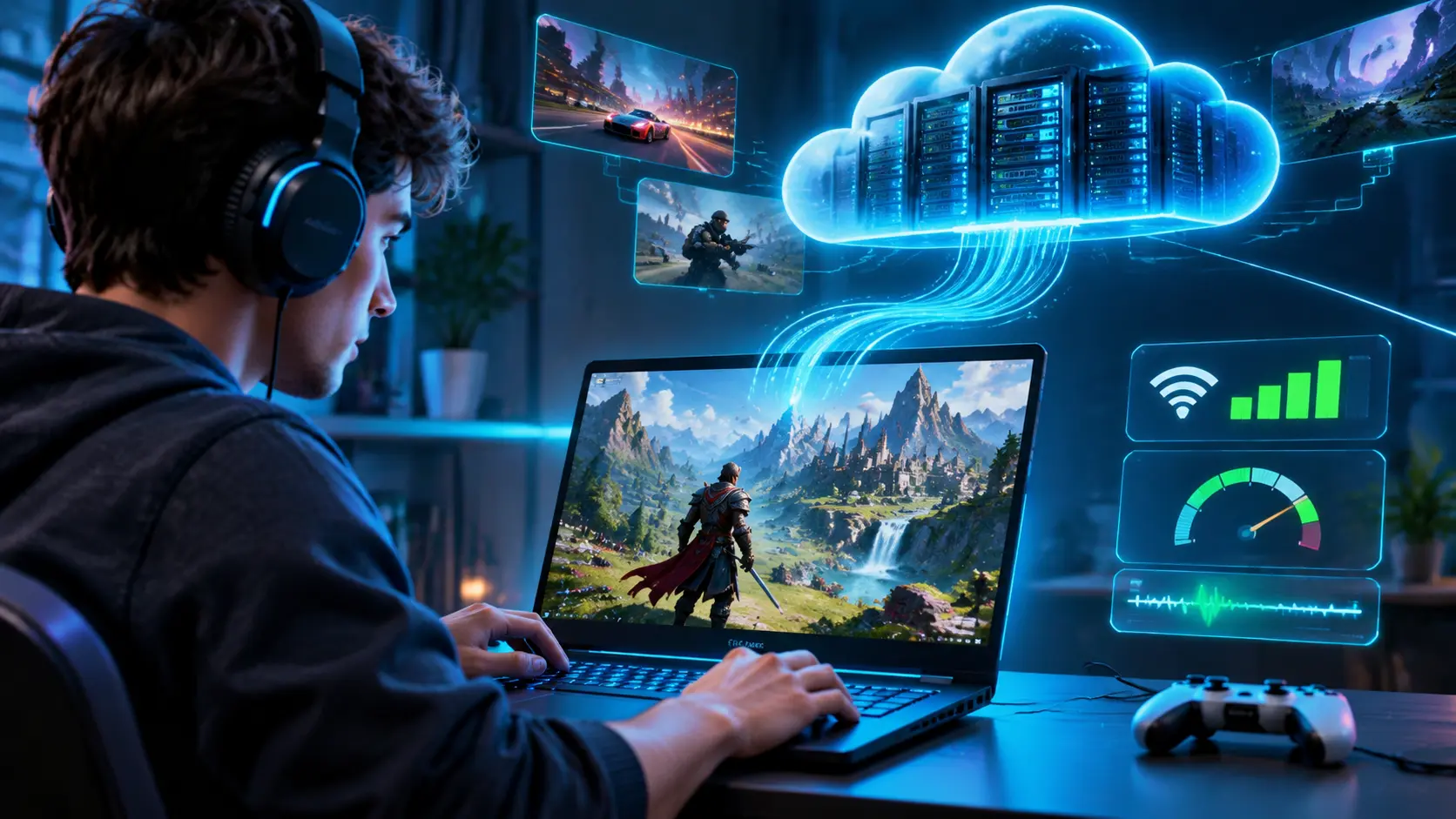
Cloud Gaming and Game Streaming
Cloud gaming changes where a game is processed.
Instead of relying entirely on a local gaming PC or console, cloud gaming services run supported games on remote servers and stream the resulting video to a player’s device.
This allows users to access certain demanding games without owning equally powerful local hardware.
For example, someone with a compatible laptop, smartphone, or television may be able to stream a supported game through a cloud gaming service.
The main benefits include:
- Less dependence on expensive gaming hardware.
- Access to supported games across different devices.
- Reduced need for local game installations.
- Flexible gaming options.
- Easier access for players who travel frequently.
However, cloud gaming has limitations.
A stable internet connection is essential. Network congestion, latency, data limits, and service availability can affect the experience.
Competitive games that require extremely quick reactions may still perform better on local hardware.
Cloud gaming is therefore an additional way to access games, rather than a complete replacement for traditional gaming systems.
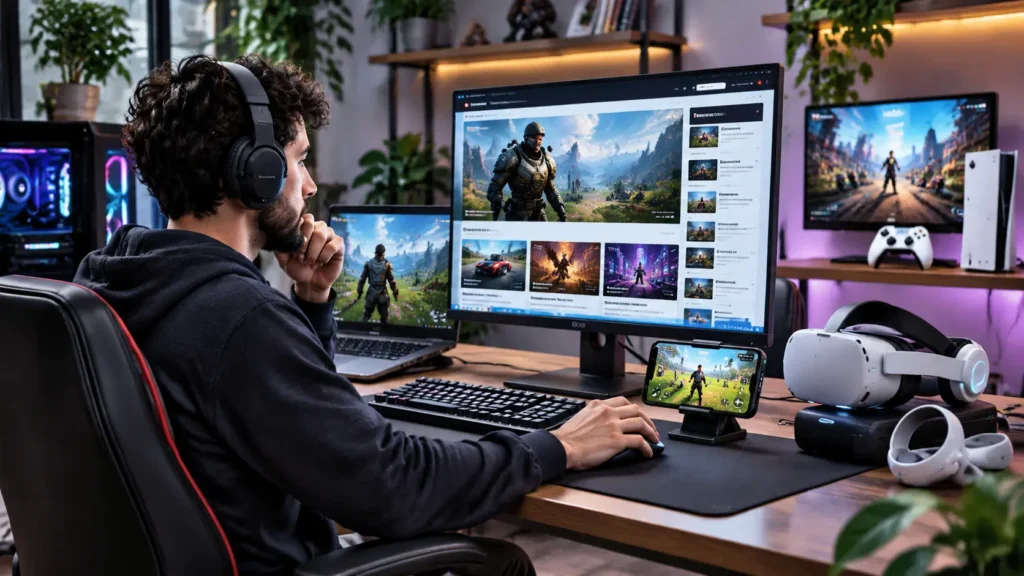
Virtual Reality and Mixed Reality
Virtual reality (VR) and mixed reality (MR) are making gaming more immersive.
VR places players inside a computer-generated environment using a headset. Instead of viewing a game through a conventional monitor, players can look around a virtual world and interact with it using supported controllers or hand-tracking systems.
Mixed reality combines digital content with views of the physical environment.
For example, a player might see virtual objects positioned around a real room and interact with them through a compatible headset.
Some important features include:
- Improved headset displays.
- Better motion tracking.
- Hand-tracking capabilities.
- Eye-tracking technology.
- More natural movement controls.
- Improved spatial audio.
These developments can make gaming feel more interactive, especially in simulation, exploration, fitness, and adventure experiences.
Nevertheless, VR and MR systems still face challenges such as device prices, comfort, battery life, limited game libraries, and motion discomfort for some players.
Not every game benefits from a headset. Traditional monitors and televisions remain more practical for many genres.
Handheld Gaming PCs
Handheld gaming PCs are becoming an important part of the gaming market.
These portable devices combine PC gaming capabilities with built-in displays, controls, batteries, and compact hardware.
Unlike many traditional handheld consoles, PC gaming handhelds can provide access to compatible PC game libraries and operating systems.
Players can use them at home, during travel, or in situations where carrying a full gaming laptop is inconvenient.
Some key features include:
- Integrated controls.
- Portable displays.
- Rechargeable batteries.
- Adjustable performance profiles.
- PC game compatibility.
- Customizable graphics settings.
However, portable gaming requires compromises.
A handheld device generally has less space for cooling and battery capacity than a full-size desktop PC. This means players may need to reduce graphics settings or frame rates to achieve longer battery life.
When choosing a handheld gaming PC, consider battery performance, screen quality, game compatibility, storage, and ergonomics rather than focusing only on processor specifications.
Advanced Haptic Feedback
Haptic feedback allows players to feel physical sensations through compatible controllers and accessories.
Traditional controllers generally use vibration motors to produce basic rumbling effects. Newer systems can deliver more detailed sensations.
For example, a compatible controller might provide different resistance when pulling a virtual bowstring or create subtle feedback when driving over different road surfaces.
The PlayStation 5 DualSense controller is a well-known example of adaptive triggers and advanced haptic feedback.
Modern haptic technology can support:
- Different vibration intensities.
- Adaptive trigger resistance.
- More detailed impact sensations.
- Environmental feedback.
- Improved immersion in compatible games.
Some VR accessories also explore wearable haptics that provide physical feedback beyond the hands.
These technologies can make gameplay more engaging, although their effectiveness depends on developer support and implementation.
Spatial Audio Technology
Sound is an important part of gaming, particularly in multiplayer and competitive environments.
Spatial audio technology helps players understand where sounds are coming from within a virtual environment.
For example, in a competitive shooter, directional audio may help identify whether footsteps are approaching from behind, above, or from another nearby position.
In adventure games, spatial audio can make environments feel more realistic by positioning environmental sounds around the player.
Important audio developments include:
- Three-dimensional sound positioning.
- Improved headphone audio processing.
- Environmental sound simulation.
- Head-tracking audio.
- More detailed directional effects.
Good audio technology can improve awareness and immersion, but it does not automatically make someone a better player. Headphones, game settings, audio implementation, and personal preferences all matter.
Cross-Platform Gaming
Cross-platform gaming allows players using different gaming systems to play together when a game supports the feature.
For example, a player using a gaming PC might join friends playing the same supported title on a PlayStation or Xbox console.
Cross-platform progression can take this further by allowing supported account information, achievements, or game progress to carry between compatible platforms.
This is particularly useful for friends who own different devices.
The advantages include:
- Larger multiplayer communities.
- More flexibility when choosing gaming hardware.
- Easier access to friends across platforms.
- Continued progress on supported devices.
- Better opportunities for cooperative gaming.
However, cross-platform gaming also introduces challenges.
Different devices can have different control methods, performance levels, and input advantages. Developers must also handle account linking, matchmaking, and compatibility.
Cross-platform functionality is not universal, so players should check individual game requirements before purchasing.
Gaming Subscriptions and Digital Libraries
Gaming subscriptions are changing how people access video games.
Instead of purchasing every title individually, players can pay a recurring fee to access a library of supported games.
This model can be useful for gamers who enjoy trying different genres or regularly exploring new releases.
Subscription services may offer:
- Access to multiple games.
- Online multiplayer benefits.
- Discounts on selected purchases.
- Cloud gaming options where supported.
- Additional content or member benefits.
However, subscription libraries can change over time. A game included today may not remain available indefinitely.
Players should compare monthly costs, available titles, supported devices, and cancellation policies before choosing a service.
How New Gaming Technology Is Changing the Player Experience
The biggest advantage of modern gaming technology is that different innovations work together
Consider a player using a modern gaming PC.
An advanced GPU can process detailed environments, AI upscaling can improve rendering efficiency, a high-refresh-rate monitor can display smoother movement, and spatial audio can help identify sounds within the game world.
A console player may benefit from improved image reconstruction, faster storage, and advanced controller feedback.
Meanwhile, a mobile gamer may appreciate cloud streaming, better wireless connectivity, and more efficient mobile processors.
The actual benefits depend on the games being played and the equipment available.
Modern gaming is therefore becoming less about one impressive specification and more about how well the entire system works together.
Gaming Technology Comparison: Old vs. New
| Gaming feature | Traditional technology | Modern development |
|---|---|---|
| Graphics | Conventional rendering | AI upscaling and advanced lighting |
| NPC behavior | Scripted responses | Emerging AI-driven interactions |
| Storage | Mechanical hard drives | High-speed SSDs |
| Audio | Basic stereo sound | Spatial audio |
| Controllers | Standard vibration | Advanced haptics and adaptive triggers |
| Gaming access | Primarily local hardware | Local gaming and cloud streaming |
| Multiplayer | Platform-specific | Cross-platform play where supported |
| Portable gaming | Dedicated handheld consoles | Handheld gaming PCs |
These developments do not mean traditional technology has become useless. Many conventional gaming systems still deliver excellent experiences.
The important difference is that modern technologies offer more ways to improve performance, accessibility, and immersion.
What New Gaming Technology Means for PC, Console, and Mobile Players
Different gaming platforms benefit from technological improvements in different ways.
PC gamers
PC gamers generally have greater control over hardware upgrades and graphics settings. New GPUs, faster storage, AI upscaling, and high-refresh-rate monitors can improve performance and image quality.
The main challenge is cost. Building or upgrading a powerful gaming PC can require a significant investment.
Console gamers
Console players benefit from optimized hardware and software integration. Developers can focus on a defined hardware configuration, making performance optimization more predictable.
Features such as advanced controller feedback and AI-powered graphics reconstruction can also improve the experience without requiring players to build a gaming PC.
Mobile gamers
Mobile gaming benefits from more efficient processors, improved displays, faster network connectivity, and better battery management.
Cloud gaming may also expand access to demanding titles on compatible mobile devices.
However, touchscreen controls, thermal limitations, battery life, and mobile data costs remain important considerations.
Is It Worth Upgrading Your Gaming Setup in 2026?
Not every new gaming innovation requires an immediate hardware upgrade.
The best decision depends on your current setup, favorite games, and performance expectations.
Consider these situations:
- Your games frequently lag: Investigate your CPU, GPU, memory, temperatures, and background applications before purchasing new hardware.
- Your graphics look outdated: A newer GPU or compatible upscaling feature may help.
- Your loading times are long: Moving to an SSD may make a noticeable difference if your system still uses slower storage.
- You travel frequently: A handheld gaming PC may offer greater convenience.
- You enjoy immersive experiences: A compatible VR headset may be worth considering.
- You play competitive multiplayer games: Prioritize stable frame rates, low input latency, and a reliable internet connection.
Before spending money, check whether your existing equipment supports software updates or performance features that could solve the problem.
An upgrade should address a genuine limitation in your gaming experience, not simply follow a marketing trend.
Challenges and Limitations of Modern Gaming Technology
Although gaming technology offers exciting possibilities, it also creates challenges for players and developers.
Increasing hardware costs: Powerful GPUs, processors, memory, and storage can make high-end gaming expensive. Circana’s 2026 US market forecast also identifies rising component costs as a potential pressure on hardware affordability. Circana
Internet dependency: Cloud gaming and many multiplayer features require stable connectivity. Players with unreliable connections may experience interruptions or latency.
Compatibility issues: Not every game supports every graphics feature, controller, headset, or platform.
AI-related concerns: AI-generated content raises questions about creative control, intellectual property, quality, and responsible development.
Privacy and security: Connected games and gaming accounts can involve personal information, payment details, and behavioral data. Players should use strong passwords and appropriate privacy settings.
Accessibility: Advanced gaming equipment may remain too expensive or physically uncomfortable for some players.
Recognizing these limitations helps gamers make better purchasing decisions and understand where new technology is genuinely useful.
What Does the Future of Gaming Technology Look Like?
The future of gaming will likely involve deeper integration between artificial intelligence, graphics processing, cloud infrastructure, and immersive hardware.
AI could help create more responsive characters and personalized gameplay experiences. Improvements in graphics reconstruction may allow less powerful devices to deliver better visual quality.
Cloud infrastructure may also make supported games more accessible across different screens and devices.
Meanwhile, VR and mixed reality could introduce new ways to interact with virtual environments.
However, progress will depend on more than technical innovation. Developers must also consider affordability, accessibility, performance, privacy, and the quality of the actual gameplay.
For players, the most meaningful improvements will be the ones that make games more enjoyable, responsive, accessible, and convenient.
Frequently Asked Questions
What is new in gaming technology Jogametech?
New gaming technology discussed in the Jogametech context includes artificial intelligence, AI-powered graphics, cloud gaming, VR and mixed reality, handheld gaming PCs, advanced haptics, spatial audio, and cross-platform play.
What is the newest gaming technology in 2026?
Some important developments in 2026 include AI-powered graphics reconstruction, improved frame generation, emerging AI-driven game development, and more advanced gaming hardware. Sony’s QSSR technology is one recent example of AI-guided graphics upscaling.
How is artificial intelligence changing video games?
AI is helping developers improve NPC behavior, automate game testing, generate content variations, and create more responsive gaming environments. Its practical impact depends on how developers implement it.
Is cloud gaming better than traditional gaming?
Cloud gaming offers convenience and reduces dependence on expensive local hardware. Traditional gaming can provide more consistent performance and lower latency, especially for competitive players with powerful local systems.
What gaming technology improves graphics?
Modern graphics improvements include ray tracing, path tracing, AI upscaling, frame generation, and more powerful graphics processors. These technologies improve visual quality and rendering performance in different ways.
Are handheld gaming PCs worth buying?
Handheld gaming PCs can be useful for players who want access to compatible PC games while traveling or relaxing away from a desktop setup. Battery life, device weight, performance, and game compatibility should influence the decision.
How does cross-platform gaming work?
Cross-platform gaming allows players on different supported devices to play together. Developers enable this functionality through compatible multiplayer systems, account services, and matchmaking features.
Will AI replace human game developers?
AI is more likely to become an additional development tool than a complete replacement for human game creators. Creative direction, storytelling, game design, and quality decisions still require human judgment.
Does new gaming technology make gaming more expensive?
It can. Advanced graphics cards, high-end monitors, VR headsets, and other accessories can increase the cost of gaming. However, cloud gaming, subscription services, and improvements to existing hardware can offer alternative ways to access games.
What should gamers upgrade first?
The best upgrade depends on the biggest limitation in the current setup. Players should identify whether the problem involves graphics performance, loading times, memory, display quality, connectivity, or battery life before purchasing new equipment.
Final Thoughts
Gaming technology in 2026 is evolving through improvements in artificial intelligence, graphics, hardware, cloud services, and immersive experiences. These developments are giving players more ways to enjoy games, whether they use a desktop PC, console, handheld device, or smartphone.
The most important thing is understanding which innovations offer practical benefits. Not every new feature is necessary, and not every expensive upgrade will improve every gaming experience.
By following developments covered by gaming platforms such as Jogametech and evaluating new technologies based on real-world performance, players can make more informed decisions about their gaming experiences.